
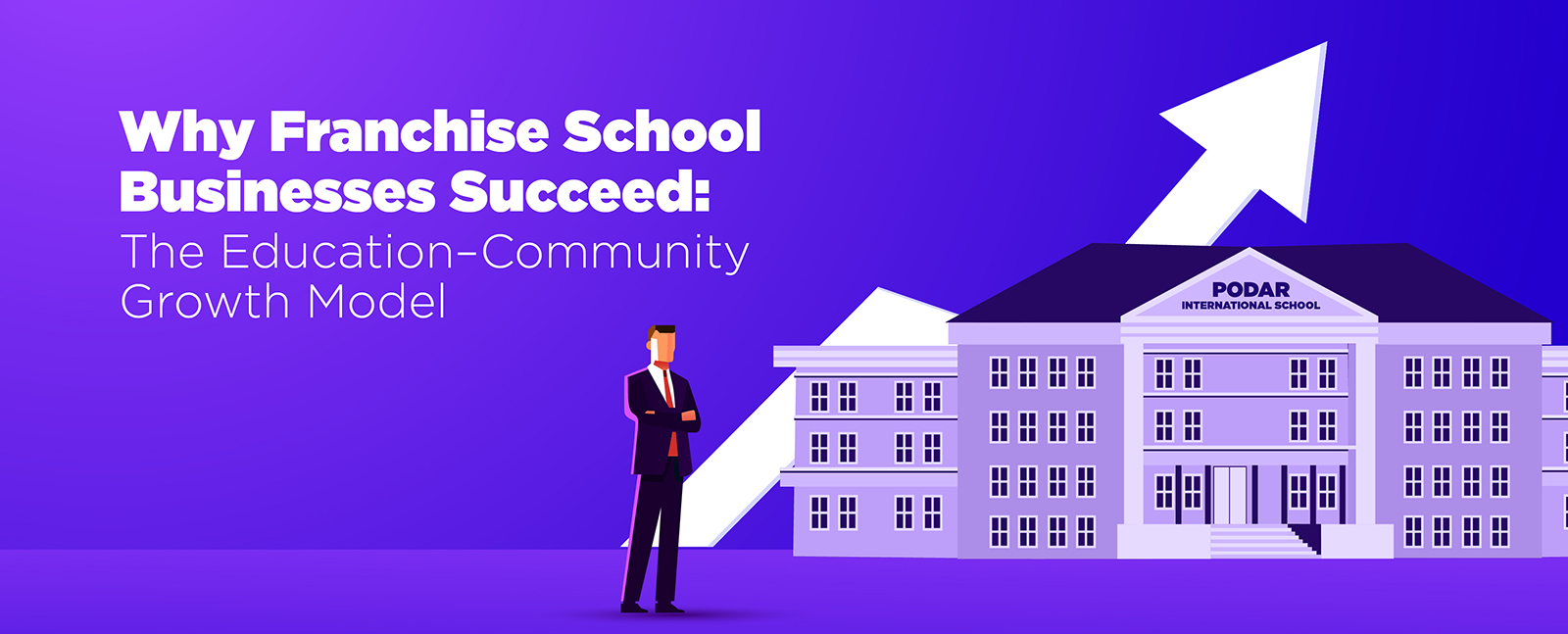
Franchise school models are becoming an increasingly effective way for education systems to create sustainable educational environments that provide quality education in a rapidly changing education environment. Among these, Podar Smarter School has set a benchmark with a combination of academic achievement and community-based approaches. But what really makes franchise based school business successful? The answer lies in a powerful framework – the Education-Community Growth Model.
Enquiry Form
1. Education Quality as the Foundation
Quality education is the foundation upon which every successful school is built. Franchise schools that deliver an established educational model, such as the NEP-aligned curriculum of Podar Smarter School, provide a constant learning experience to students, which yields consistent student outcomes. Established curriculum models also reduce uncertainty for new school operators, ensuring that students receive the same high-quality education from the moment they enter the school. Additionally, franchise schools utilizing an established educational model provide investors with a proven framework and assure parents that their children are receiving a quality education based on the school’s proven track record.
2. Strong Brand Trust and Reputation
Competition in the education industry has grown to the point that parents are seeking out schools that have earned a reputation for excellence. A franchise school model like Podar Smarter School relies on an established school brand that has gained trust and respect from parents and students. The use of an established school brand provides a means for a franchise school to establish instant credibility with parents and students, thereby increasing enrolment. In addition to establishing credibility with parents and students, a franchise school also saves money by not having to spend significant amount of money on marketing to attract parents and students to a new school. An established school brand also fosters goodwill toward the school from the local community.
3. Community-Driven School Growth
The success of a franchised school is built on its ability to develop as an integral part of the community in which it serves. This means that beyond being a place where students learn, schools can also be places where their communities grow and thrive through parent involvement, hosting cultural programmes and academic events, offering social outreach and support, and partnering with local community, organizations, government agencies, and other civic entities. Podar Smarter School supports its franchisees in building positive partnerships with all stakeholders within the community, enabling the school to become the central location for developing and sustaining community development.
4. Operational Support That Ensures Stability
School operation can be overwhelming for many an entrepreneur who dreams of owning one. However, a franchise school model such as that provided by Podar Smarter School makes it easier to establish schools. The franchise school model provides all the necessary operational support, which includes designing the overall infrastructure of your school (including classrooms, libraries etc.), hiring and managing staff, developing and delivering educational content, implementing systems such as a school management system (ERP) to manage day to day operations, supporting with all aspects of marketing and providing ongoing training for you and your staff to help you avoid making the most common errors and to ensure your school operates smoothly on a daily basis.
5. Scalability and Financial Sustainability
Another factor that contributes to the high success rates of franchise schools is that they provide a balance of financial sustainability and social impact. With the growing demand for quality education in Tier 2 and Tier 3 cities, a school has the opportunity to significantly expand the number of students that it enrols. When a school has a strong brand and a solid system, it can add classrooms and resources and ultimately increase the school’s size and generate long-term revenue. The school benefits from better facilities and a larger student body, while the school owner enjoys a steady stream of income and the possibility of generating long-term profits.
6. A Cycle of Mutual Growth
The Education–Community Growth Model is effective because it creates a cycle of mutual benefit between the school and the community. By improving the quality of education available to students in a community, a school can improve the literacy levels of those in the community, improve job opportunities and improve the economic mobility of those in the community. At the same time, the community is crucial to the continued operation and success of a school. The community helps the school grow by attracting more students, fostering partnerships, and positively recommending the school, thereby enabling the school to evolve and meet the changing needs of the community.
Franchise school businesses flourish as more than just schools; they are transformative in their own right. Through its strong educational foundation and community involvement, combined with the heritage of the Podar name, Podar Smarter School offers entrepreneurs the opportunity to build a sustainable and profitable business that leaves a lasting, positive footprint on society.